Gas sauna heaters occupy a unique position in the sauna world. They deliver the high heat output and authentic steam production of a traditional Finnish sauna without requiring the heavy-amperage electrical circuits that large electric heaters demand. For sauna owners who want powerful, efficient heating — especially in larger rooms, commercial facilities, or off-grid locations — a gas sauna heater is often the best option available.
Despite their advantages, gas sauna heaters remain less well-known than their electric counterparts. Most sauna buyers are familiar with brands like Harvia or HUUM in the electric space, but fewer understand how gas models work, what they cost to operate, or what's involved in installing one. This guide covers all of it — from how gas sauna heaters generate heat, to the differences between natural gas and propane configurations, to the exact BTU sizing calculations you need to choose the right unit for your sauna room.

What Is a Gas Sauna Heater and How Does It Work?
A gas sauna heater is a floor-mounted heating unit that burns either natural gas or liquid propane to heat a mass of sauna stones. Those stones absorb the thermal energy and radiate it into the surrounding air, raising the sauna room temperature to between 150°F and 200°F — the same temperature range as any traditional Finnish sauna heated by electric or wood-burning stoves.
The fundamental heating process is the same across all traditional sauna heater types: heat the stones, the stones heat the air, and when you pour water over the hot stones, you produce steam (called löyly in Finnish). What sets gas heaters apart is their fuel source and the way they manage combustion.
Gas sauna heaters use a sealed combustion design. The burner assembly ignites inside a fire chamber, and the combustion heat transfers through internal baffles that are welded into the heater body. These baffles slow the airflow inside the unit, forcing the heat to linger rather than escape immediately up the flue. The result is more efficient heat transfer to both the rock tray above and the surrounding sauna air. Cool air is drawn in through the body of the heater, heated as it passes over the fire chamber, and then circulated into the room.
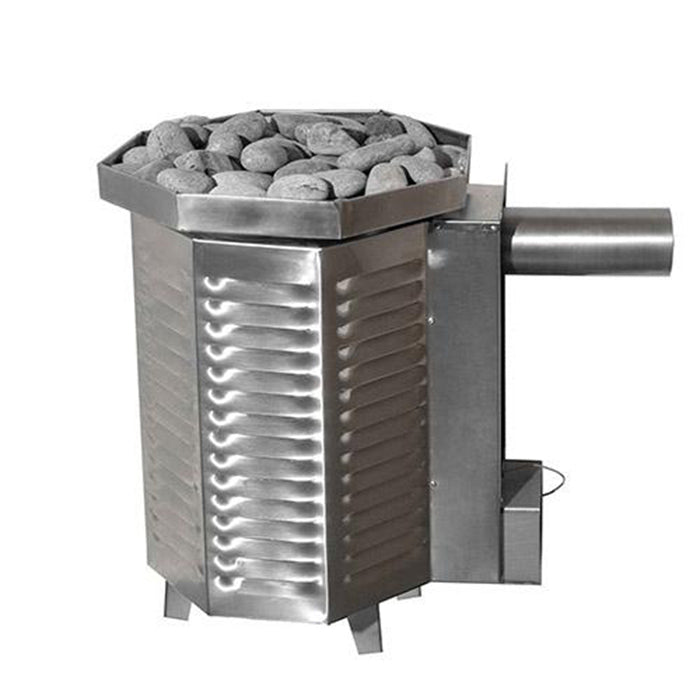
Because combustion occurs inside a sealed chamber, no gas connections or flue pipes are exposed inside the sauna room itself. All venting and gas supply lines run through the wall behind the heater, which eliminates the possibility of oxygen depletion or combustion byproducts entering the bathing space. The controls — a thermostat and timer — are also mounted on the exterior wall outside the sauna, so you adjust temperature and set your session length without opening the door.
Natural Gas vs. Propane Sauna Heaters
All gas sauna heaters run on one of two fuel types: natural gas (NG) or liquid propane (LP). Most gas heater models are available in both configurations — you choose your fuel type at the time of purchase. The heater's internal burner and gas valve are calibrated for the specific fuel, so this is not something you can switch after the fact without a conversion kit.
Here's how the two fuel types compare:
Natural gas is piped directly to your home through a utility gas line. If your house already has natural gas service (for a furnace, water heater, or stove), extending a gas line to your sauna is typically straightforward for a licensed HVAC professional. Natural gas is one of the cleanest-burning fossil fuels, producing fewer emissions than coal, oil, or wood. It's also generally the cheaper option per BTU in areas with established natural gas infrastructure. The main limitation is that your sauna location needs to be within reasonable distance of an existing gas line. Browse our natural gas sauna heaters here.
Liquid propane (LP) is stored in an external tank near the sauna and connected via a gas line. This makes propane the go-to option for properties without natural gas service, rural installations, off-grid saunas, and mobile or remote sauna builds where running a gas utility line isn't practical. Propane is also a clean-burning fuel with high energy density. The trade-off is that propane typically costs more per BTU than natural gas, and you'll need to manage tank refills. Browse our propane sauna heaters here.
From a performance standpoint, both fuel types produce the same heat quality and the same BTU output for a given heater model. The choice between them comes down to what fuel source is available and cost-effective at your location.
BTU Sizing: How to Choose the Right Gas Sauna Heater
Gas sauna heaters are rated in BTUs (British Thermal Units) rather than kilowatts. The BTU rating tells you how much heat the unit can produce, which directly determines the maximum sauna room size it can handle effectively.
The general sizing rule for gas sauna heaters is approximately 1,000 BTUs per 15 cubic feet of sauna room volume. To calculate your sauna's volume, simply multiply the length × width × height of the interior space in feet.
For example, a sauna room measuring 6' wide × 8' long × 7' tall has a volume of 336 cubic feet. At 1,000 BTUs per 15 cubic feet, that room needs roughly 22,400 BTUs — well within the range of a 40,000 BTU heater.
The two most common gas sauna heater sizes available are:
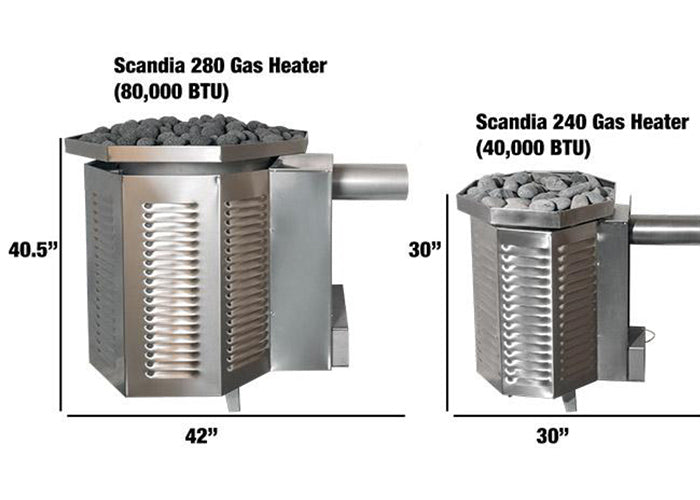
40,000 BTU (Scandia Model 240) — Designed for sauna rooms up to 616 cubic feet. This is the right size for most residential saunas, including 4–6 person barrel, cabin, and pod saunas. Dimensions: 28"H × 18.5"W × 21"D. Weight: 300 lbs. Rock capacity: 80 lbs. Water capacity: 4 gallons.
80,000 BTU (Scandia Model 280) — Built for large and commercial sauna rooms that exceed the 40K model's capacity. If you're building a large cabin sauna, a gym sauna, or any commercial installation, this is the model to specify. The minimum recommended room size is 5' × 7' × 7' due to the unit's physical dimensions and power rating, and it can heat rooms up to approximately 8' × 10' × 7'.
When to size up: If your sauna volume falls between the two models, or if your sauna has significant glass panels, poor insulation, or is located outdoors in a cold climate, always choose the larger heater. An undersized gas heater will struggle to reach and maintain temperature, and the rocks won't get hot enough to produce satisfying steam. Oversizing slightly is far better than undersizing. Use our sauna heater sizing calculator to get a quick recommendation based on your room dimensions.
Standing Pilot Light vs. Piezo Ignition
Gas sauna heaters are available with two ignition systems, and understanding the difference helps you choose the right configuration for your setup:
Standing pilot light is the traditional ignition method. A small flame burns continuously inside the heater, ready to ignite the main burner whenever you turn the unit on. The standing pilot is reliable and simple — it doesn't require batteries or electricity. The trade-off is that the pilot flame uses a small amount of gas even when the heater isn't actively running, which means slightly higher fuel consumption over time.
Piezo ignition is a more modern, energy-efficient approach. It uses the piezoelectric effect — a spark generated by mechanical pressure on a crystal or ceramic element — to ignite the gas when you activate the heater. No external power source, no batteries, and no gas consumption when the unit is idle. The piezo models are generally a slightly higher upfront cost, but they're more efficient for saunas that aren't used daily.
Both ignition types are safe and reliable. The choice often comes down to personal preference and usage frequency. If you're running a commercial sauna daily, a standing pilot ensures instant readiness. For residential use where you may sauna a few times per week, a piezo ignition avoids wasting fuel between sessions.
Venting Options: Horizontal vs. Vertical
Because gas sauna heaters produce combustion byproducts, they require proper venting to the outside. There are two venting configurations available:
Horizontal (direct) venting exhausts through the wall directly behind the heater using a flue cap. This is the simplest and most common installation for saunas built against an exterior wall. The heater's back panel assembly passes through the wall, and the flue cap directs exhaust gases outside.
Vertical venting runs the exhaust up through the ceiling and roof using a draft hood and flue pipe. This is necessary when the heater doesn't back up to an exterior wall, or when the sauna layout requires an upward exhaust path. Vertical venting requires a minimum rise of at least 1/4 inch per foot of pipe run, and long runs with multiple turns may require additional air circulation equipment.

Your HVAC installer will determine the best venting approach based on your sauna's design, location (indoor vs. outdoor), ceiling height, bench layout, and proximity to exterior walls. This is one of the many reasons professional installation is mandatory for gas sauna heaters.
Installation Requirements
This is probably the most important section if you're considering a gas sauna heater. Unlike electric sauna heaters that can be installed by a qualified electrician, gas heaters require a licensed HVAC professional for installation. This is non-negotiable — improper installation can void your warranty, create safety hazards, and violate local building codes.
Here's what the installation involves:
Gas line connection: The HVAC contractor will run a properly sized gas line from your home's natural gas supply (or from an exterior propane tank) to the heater location. The pipe diameter must be adequate for the BTU requirement and the distance from the gas source to the heater. The contractor will also set the correct gas pressure for your specific unit.
Fresh air intake: Gas heaters require an external air intake that is separate from the sauna's breathing ventilation system. This dedicated combustion air supply ensures the heater has the oxygen it needs to burn efficiently without depleting the air inside the sauna room.
Exhaust venting: As described above, the heater needs either horizontal or vertical venting to the outdoors. The sauna stove must be connected to its own dedicated flue system.
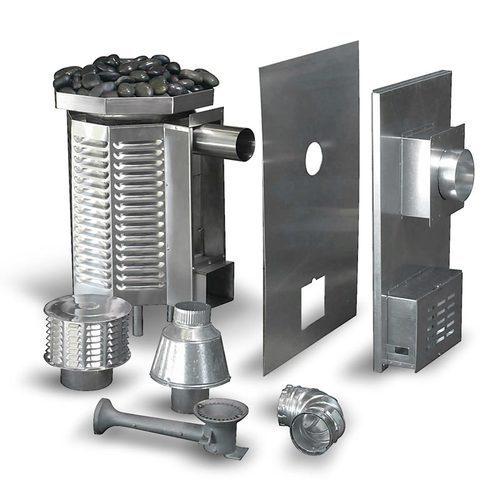
Wall penetration and back panel assembly: The heater's through-wall assembly, internal wall flashing, and back panel are all included with the unit. If your exterior wall is thicker than 5.5 inches, you'll need a gas extension kit.
Non-combustible surfaces: The floor and walls surrounding the heater must be non-combustible materials. Check local regulations regarding clearances from the heater to the ceiling and walls.
Control placement: The temperature and timer controls mount on the wall outside the sauna room. Power outlets cannot be installed inside the sauna room itself.
Once the installation is complete, the contractor will fire the heater for the first time. Before your first bathing session, let the heater run for approximately 30 minutes to allow the factory paint to cure — this prevents off-gassing into the sauna during your first use.
Gas vs. Electric Sauna Heaters: Key Differences
If you're weighing a gas sauna heater against an electric model, here are the main factors to consider:
No high-amperage electrical service required. This is the single biggest practical advantage of gas. Electric sauna heaters in the 6–9kW range require a dedicated 240V, 30–50 amp circuit, and larger commercial heaters need even more. If your sauna location doesn't have electrical service — or running a dedicated high-amperage circuit would be expensive — a gas heater eliminates that requirement entirely.
Lower operating cost in most areas. Running a 40,000 BTU gas sauna heater costs approximately $0.50–$0.60 per hour on natural gas or propane, depending on your local fuel prices. In many parts of the country, this is significantly less than the electricity cost of running an equivalent-output electric heater — in some cases up to 50% less.
Softer, more comfortable heat. Gas sauna enthusiasts consistently describe the heat quality as softer and more enveloping compared to the radiant "sizzle" of electric heating elements. This is subjective, but it's a point that comes up frequently in sauna communities and from experienced bathers. The heat distribution from gas combustion tends to feel more even and less directional.
Superior steam production. Gas sauna heaters like the Scandia models feature the largest rock trays in the industry, holding up to 80 lbs of stones and up to 4–8 gallons of water capacity. That means heavy, sustained löyly when you pour water over the stones — exactly what you want for an authentic Finnish sauna experience. Many electric heaters have smaller stone trays that produce shorter bursts of steam.
No heating elements to replace. Electric sauna heaters rely on resistive heating elements that degrade over time and eventually burn out — a replacement cost that recurs throughout the heater's life. Gas heaters have no electric heating elements. The burner assembly and gas valve are the primary working components, and they're far less prone to wear. This means lower long-term maintenance costs.
Higher upfront cost and more complex installation. The main downside of gas. The heaters themselves cost more than most electric models, and professional HVAC installation adds to the initial investment. Electric heaters are simpler to install and don't require gas lines or flue venting.
Less precise temperature control. Electric heaters — especially modern models from brands like HUUM and Harvia with WiFi-enabled digital controllers — offer precise, set-it-and-forget-it temperature management. Gas heaters use mechanical thermostats, which are reliable but less granular. You won't have smartphone pre-heating or degree-level precision.
For a detailed breakdown, read our full guide: How to Choose the Right Sauna Heater: Electric vs. Wood-Burning vs. Gas.
Heat-Up Time and Performance
Gas sauna heaters typically bring a properly insulated sauna room to bathing temperature (170–185°F) within 30 to 60 minutes, depending on the room size, insulation quality, starting ambient temperature, and outdoor conditions. This is comparable to most electric heaters and faster than many wood-burning sauna stoves.
One area where gas heaters particularly excel is heat recovery. When you open the sauna door, pour a large amount of water on the stones, or have multiple people cycling in and out, the room temperature drops temporarily. Gas heaters recover that lost heat quickly due to their high BTU output, making them excellent performers in cold climates and in commercial settings where the sauna sees continuous use throughout the day.
Gas heaters also don't need recovery time between consecutive sessions. Multiple family members or guests can sauna back-to-back without waiting for the heater to catch up — the stones stay hot and the room temperature stays consistent.
Safety Features and Certifications
Modern gas sauna heaters are built with multiple layers of safety protection:
CSA certification. Look for gas heaters that carry CSA (Canadian Standards Association) certification, which is recognized in both the United States and Canada. CSA certification is similar to UL listing and confirms that the heater has been independently tested to meet rigorous safety standards for gas-fired appliances.
Thermopile safety shutoff. A thermopile built into the pilot assembly continuously monitors whether the pilot light is lit. If the flame is blown out by wind or any other cause, the gas valve automatically shuts off all gas flow until the pilot is manually relit.
Backdraft sensor. This sensor detects if exhaust gases begin flowing backward through the chimney (which can happen during strong winds). If backdrafting is detected, the heater shuts down to prevent combustion gases from entering the sauna.
Over-temperature sensor. If the exterior of the heater exceeds safe temperature limits for any reason, the unit temporarily pauses heating until the temperature drops back to a safe range.
Sealed combustion design. As mentioned earlier, sealed combustion means no gas connections or flue pipes are inside the sauna room. This eliminates the possibility of oxygen depletion or combustion byproducts leaking into the bathing space.
Timer with automatic shutoff. Standard gas heaters include a 60-minute timer that automatically shuts the heater off after the set time. For commercial installations, a 24-hour programmable digital timer is available so you can schedule operating windows throughout the day.
What's Included With a Gas Sauna Heater
When you purchase a gas sauna heater from Haven of Heat, the unit ships as a complete package. Here's what's in the box:
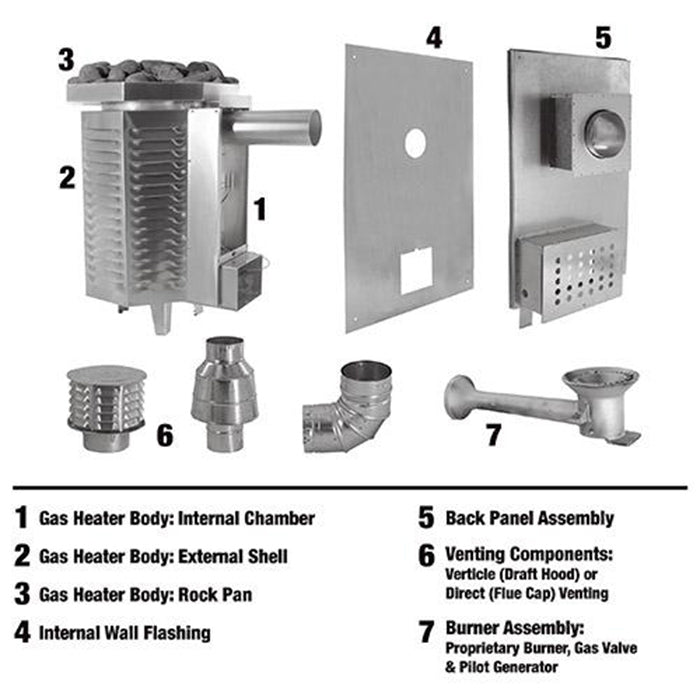
- Sauna heater body with rock tray (fire chamber: 321 spec stainless steel; exterior shell: 304 spec brushed stainless steel)
- High-density sauna stones
- Internal wall flashing (304 spec brushed stainless steel)
- Back panel assembly (22 gauge galvanized steel)
- Venting components — flue cap for horizontal venting or draft hood for vertical venting
- Burner assembly with proprietary burner, gas valve, and pilot
- "G" wall controls with 60-minute timer and mechanical thermostat
- Installation manual
- 10-year limited manufacturer warranty
Everything you need for installation is included except the gas line itself, which your HVAC professional will supply and size based on your specific setup.
Who Makes Gas Sauna Heaters?
The gas sauna heater market is significantly smaller than the electric heater market. There are only a handful of manufacturers producing quality gas units, and the clear leader is Scandia Manufacturing.
Scandia is the only manufacturer of gas sauna heaters in the United States and has been building sauna heaters since 1964. Their Ultra-Sauna gas heater line is used in health clubs, spas, gyms, hotels, and residential saunas across every state in the country. The fire chambers are constructed from 321 spec stainless steel — the same alloy specification used in jet engine afterburners — which ensures exceptional heat resistance and corrosion protection under the extreme conditions inside a sauna.
The other notable manufacturer is Torch, which produces the TS-60F (60,000 BTU) and TS-80F (80,000 BTU) models. Torch heaters are also made in the USA, carry CSA certification, and feature a similar baffle-based heating design.
At Haven of Heat, we carry the full Scandia gas sauna heater lineup as an authorized dealer, including both the 40K and 80K BTU models in all fuel type, ignition, and venting configurations.
Operating Cost Breakdown
One of the most common questions we get is how much it costs to run a gas sauna heater compared to electric. Here's a realistic breakdown:
A Scandia 40,000 BTU gas heater uses approximately 0.5 pounds (0.12 gallons) of propane per hour of operation. At typical residential propane prices, that works out to roughly $0.50–$0.60 per hour of run time. Natural gas is generally even cheaper, though exact costs vary by region and utility rates.
A comparable electric heater running at 6–9kW draws significant electricity. At the national average residential electricity rate, a 9kW electric heater costs approximately $1.00–$1.50 per hour to run. In states with high electricity rates (California, Hawaii, New England), the gap widens even further.
For a typical residential sauna session of 1–1.5 hours (including heat-up time), you're looking at roughly $0.60–$0.90 per session on gas versus $1.00–$2.25 per session on electric. Over a year of regular use — say 4 sessions per week — those savings compound into hundreds of dollars annually.
The other long-term cost advantage is maintenance. Electric heaters require periodic replacement of their heating elements, which can cost $100–$300+ depending on the brand and model. Gas heaters have no heating elements to replace, so that recurring cost is eliminated entirely.
When a Gas Sauna Heater Is the Right Choice
Gas isn't the right fit for every sauna, but it's the ideal choice in several specific scenarios:
Large sauna rooms: If your sauna exceeds 400–500 cubic feet, a gas heater delivers the BTU output needed to heat the space quickly and maintain temperature consistently. Large electric heaters exist, but they require substantial electrical infrastructure.
Commercial and high-traffic installations: Gyms, spas, hotels, and health clubs benefit from the fast heat recovery, low operating cost, and durability of gas heaters. The Scandia units are built for exactly this kind of daily, heavy-use environment.
Off-grid or remote saunas: If your sauna location doesn't have electrical service, a propane gas heater paired with an external tank gives you full sauna capability without any electrical requirement. This makes gas heaters popular for cabin saunas, lakeside builds, and outdoor gas-powered saunas.
Cold climate outdoor saunas: In regions with harsh winters, the high BTU output and fast recovery of a gas heater make it a superior performer compared to electric models that may struggle to maintain temperature when the outside air is well below freezing.
Homeowners prioritizing low operating cost: If you sauna frequently and want to minimize ongoing energy costs, gas is typically the more economical choice — especially if you already have natural gas service.
When an Electric Heater Might Be Better
Gas sauna heaters aren't the right fit for every situation. Consider an electric sauna heater if:
- Your sauna is a smaller room (under 300 cubic feet) where a compact electric heater provides plenty of heat
- You want WiFi control, smartphone pre-heating, and precise digital temperature management
- Your sauna is an indoor installation (basement, spare room) where running gas lines and flue venting would be impractical
- You prefer a simpler, lower-cost installation that a qualified electrician can handle
- Local building codes or HOA restrictions limit gas appliances in your area
We carry electric heaters from all the top brands including HUUM, Harvia, Saunum, and Scandia electric models. Browse our full sauna heater packages to find the right fit for your build.
Maintenance and Longevity
Gas sauna heaters are relatively low-maintenance compared to electric and wood-burning models, but they do require periodic attention to stay safe and efficient:
Annual professional inspection: Have your HVAC professional inspect the gas connections, burner assembly, pilot, flue system, and safety sensors at least once per year. This is similar to getting your home furnace serviced and ensures everything is operating within safe parameters.
Check the pilot light and ignition system: If your heater uses a standing pilot, visually confirm it's lit before each use. If it's gone out, relighting is straightforward — turn the control knob to "Off," wait five minutes for any residual gas to dissipate, then follow the lighting instructions in your installation manual. The process is identical to relighting a gas fireplace.
Inspect the flue and venting: Make sure the exhaust vent is clear of debris, bird nests, or obstructions that could cause backdrafting. This is especially important for outdoor installations or saunas in wooded areas.
Sauna stones: Over time, sauna stones can crack and degrade from repeated thermal cycling. Check your stones periodically and replace any that are crumbling or broken. This applies to all sauna heater types, not just gas. We carry replacement sauna stones for all heater brands.
Clean the rock tray: Mineral deposits from water and stone dust can accumulate in the rock tray over time. Remove the stones periodically, clean the tray, and reload with fresh or cleaned stones.
With proper maintenance, a quality gas sauna heater can deliver years of reliable service. The stainless steel construction of the Scandia models is specifically designed to resist the extreme heat and moisture conditions inside a sauna, and the absence of electric heating elements means there's one fewer wear component to worry about.
Frequently Asked Questions About Gas Sauna Heaters
Do gas sauna heaters require electricity?
No. Gas sauna heaters with standing pilot ignition require no electricity at all — the pilot light is lit manually and the gas valve is entirely mechanical. Piezo ignition models generate their own spark mechanically as well, with no external power source needed. The only electrical component is the optional 24-hour digital timer, which requires a 120V power supply to the external control panel.
Can I install a gas sauna heater myself?
No. Gas sauna heaters must be installed by a licensed HVAC professional. This is required for safety, for compliance with local building codes, and to maintain your manufacturer warranty. The contractor will handle gas line sizing, pressure regulation, venting, and the initial test firing.
How long does it take to heat a sauna with a gas heater?
Typically 30–60 minutes to reach bathing temperature (170–185°F), depending on room size, insulation quality, and starting ambient temperature. You can enter the sauna a bit early and use steam (pouring water on the stones) to raise the perceived temperature more quickly.
Can I produce steam with a gas sauna heater?
Absolutely. Gas sauna heaters are designed for löyly. The Scandia models feature the largest rock trays in the industry — holding up to 80 lbs of stones — and a large water capacity that produces heavy, billowing steam when you pour water over the hot stones. Steam production is one of the strongest selling points of gas heaters.
Are gas sauna heaters safe?
Yes, when properly installed and maintained. Modern gas sauna heaters include multiple safety features — thermopile shutoffs, backdraft sensors, over-temperature sensors, sealed combustion, and automatic timers. The sealed combustion design ensures no combustion gases enter the sauna room. Professional installation and annual inspections are the two most important things you can do to ensure safe, trouble-free operation.
How much does a gas sauna heater cost?
The Scandia 40K BTU model starts at $3,600 and the 80K BTU model starts at $5,200, depending on fuel type, ignition system, and venting configuration. Installation costs vary by location and complexity but typically range from $500–$2,000 for the HVAC work. While the upfront investment is higher than most electric heaters, the lower operating costs and absence of element replacements help offset the difference over time.
What size gas sauna heater do I need?
Calculate your sauna room volume (length × width × height in feet). For rooms up to 616 cubic feet, the 40,000 BTU Scandia Model 240 is the right choice. For larger or commercial rooms, the 80,000 BTU Scandia Model 280 provides the power you need. When in doubt, size up. Use our heater sizing calculator for a quick recommendation.
Ready to Choose Your Gas Sauna Heater?
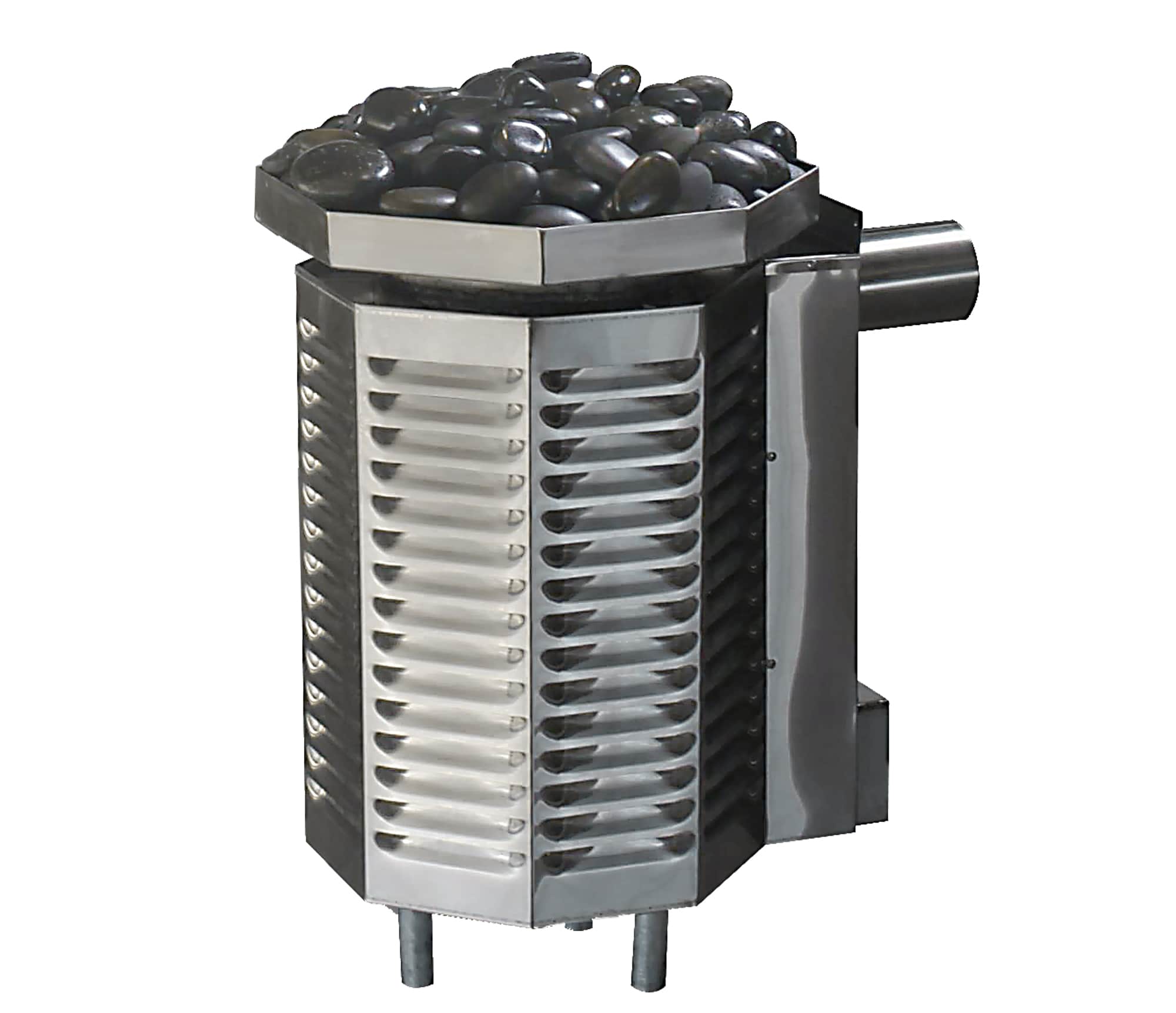
Gas sauna heaters are a serious investment in long-term sauna performance. They deliver the heat output, steam quality, and operating efficiency that demanding sauna bathers expect — without the electrical infrastructure requirements of high-wattage electric models.
Browse our complete selection of gas sauna heaters, or explore our outdoor gas-powered sauna kits that pair premium cedar structures with Scandia gas heaters for a turnkey installation. Every order ships free, and we offer 0% APR financing to make the purchase more manageable.
Not sure which heater is right for your build? Call or text our sauna experts at (360) 233-2867 — we'll help you size the right unit and answer any installation questions you have.




Leave a comment