The floor beneath your feet matters more than most sauna owners realize. While walls, benches, and heaters get most of the attention during a sauna build, the floor has to handle a punishing combination of heat, moisture, temperature swings, and bare foot traffic — day after day, year after year. Get it wrong, and you're looking at mold issues, slippery surfaces, premature deterioration, or materials that off-gas toxic fumes in a sealed, heated room.
This guide walks through every viable sauna flooring material, explains which ones belong in specific sauna types and setups, and identifies the materials you should avoid entirely. Whether you're planning a custom DIY sauna build or preparing the room for a pre-assembled sauna kit, the right floor sets the foundation — literally — for a safe and lasting sauna experience.

Why Sauna Flooring Is Different from Regular Flooring
Standard residential flooring is engineered for stable, room-temperature environments with moderate humidity. A sauna floor operates under fundamentally different conditions. Temperatures inside a traditional sauna reach 150°F to 200°F at bench height, and while the floor stays significantly cooler (heat rises, so the floor area typically hovers closer to 80°F–110°F), the materials still endure constant exposure to elevated heat, high humidity, water splashes, and the thermal stress of heating and cooling cycles every time the sauna is used.
These conditions create four non-negotiable requirements for any sauna floor material:
Moisture resistance. Saunas generate steam, sweat, and water from löyly (the steam created when pouring water over hot sauna stones). Any flooring material that absorbs water will eventually swell, warp, rot, or become a breeding ground for mold and bacteria.
Slip resistance. Wet bare feet on a smooth surface is a recipe for injury. The floor needs to maintain traction when damp without being so textured that it's uncomfortable to walk on or difficult to clean.
Chemical safety. This is the requirement most people overlook. In a sealed, heated room, materials that seem perfectly safe at room temperature can off-gas volatile organic compounds (VOCs) when exposed to sauna temperatures. Certain adhesives, sealants, laminates, and synthetic flooring products release harmful fumes that concentrate in the small, enclosed space of a sauna.
Durability under thermal stress. Repeated heating and cooling cycles put strain on rigid materials. Flooring that can't handle expansion and contraction will crack, buckle, or delaminate over time.
Ceramic and Porcelain Tile
Tile is one of the most practical and durable choices for sauna flooring, especially in high-use saunas and custom builds. Porcelain tile in particular excels in this environment because it's dense, non-porous (with water absorption rates as low as 0.1%), and completely impervious to the heat and humidity cycles inside a sauna.
From a hygiene standpoint, tile is tough to beat. It doesn't harbor bacteria or mold the way porous materials can, and it cleans easily with mild soap and water. For slip safety, choose tiles with a textured or matte surface — look for a Dynamic Coefficient of Friction (DCOF) rating of 0.42 or higher, which is the industry benchmark for wet-area flooring safety.
The main drawback of tile is that it feels cold underfoot, particularly when the sauna is first heating up. This is easily solved by placing removable cedar duckboards or slatted wood mats over the tile in the areas where you walk and sit. This two-layer approach — a durable, waterproof tile base with a warm, removable wood surface on top — is actually the gold standard recommended by experienced sauna builders.
Tile does require professional installation for the best results. Use a thin-set mortar rated for high-temperature environments, and choose a mold-resistant grout. Grout lines can accumulate grime over time, so larger format tiles with fewer grout joints simplify long-term maintenance. For outdoor sauna installations in climates with freezing temperatures, always use porcelain over ceramic — porcelain is denser and more frost-resistant, which prevents cracking during winter temperature swings.
Best for: Custom-built indoor saunas, high-use home saunas, commercial saunas, and DIY builds where you want maximum longevity.

Concrete (Sealed or Coated)
Concrete is the workhorse of sauna subfloors, and with the right surface treatment, it performs exceptionally well as a finished floor too. Many basement and garage sauna conversions already have a concrete slab in place, which eliminates a major step in the build process.
Raw concrete on its own is porous, cold, and slippery when wet — none of which are acceptable in a sauna. The solution is a proper sealing coat. A polyurea or high-temperature epoxy coating transforms concrete into a non-porous, non-absorbent, slip-resistant surface that handles heat, moisture, and thermal cycling without issue. Anti-slip aggregates can be mixed into the coating for additional traction, and the resulting surface cleans quickly and resists microbial growth.
The biggest advantage of sealed concrete is its durability. A well-coated concrete floor can last decades with virtually no maintenance. It also provides excellent drainage when sloped slightly toward a floor drain — a smart addition for any sauna that involves water use. If you're converting an existing room into a sauna, the existing concrete slab often needs nothing more than cleaning, leveling, and coating to become a perfectly functional sauna floor.
Like tile, sealed concrete can feel cold on bare feet. Removable wood duckboards or rubber mats placed over the walking areas solve this completely.
Best for: Basement saunas, garage conversions, outdoor sauna builds, and any installation where long-term durability is the priority.

Wood Flooring
Wood is the traditional sauna flooring material, and for good reason — it feels warm and natural underfoot, doesn't get uncomfortably hot even at high sauna temperatures, and creates the authentic atmosphere most sauna enthusiasts are after. That said, wood flooring in a sauna requires more thought and maintenance than hard surfaces like tile or concrete.
Not all wood species are suitable for sauna use. The best choices share specific properties: low density (so they don't conduct and retain excessive heat), natural resistance to moisture and decay, minimal resin content (to prevent sticky surfaces and fumes at high temperatures), and dimensional stability under humidity changes.
Western Red Cedar
Cedar is the most popular choice for sauna wood, and for good reason. It's naturally resistant to rot, mold, and insect damage thanks to its high content of natural oils. It has a pleasant, distinctive aroma that many sauna users consider part of the experience. Cedar is also dimensionally stable, meaning it handles humidity fluctuations with relatively little expansion and contraction. Many of the sauna kits we carry use Western Red Cedar throughout, including in floor components.
Hemlock
Hemlock is a clean, light-colored softwood that works well in saunas. It's hypoallergenic and has virtually no aroma, making it a good alternative for anyone sensitive to cedar's scent. Hemlock is widely used in infrared saunas and many pre-fabricated sauna kits.
Thermally Modified Wood (Thermo-Aspen, Thermo-Pine, Thermo-Spruce)
Thermally modified wood is heat-treated at high temperatures (around 400°F) to fundamentally alter its cellular structure. This process makes the wood highly resistant to moisture absorption, decay, and dimensional instability — without using any chemical treatments. It's one of the most stable and durable wood options for sauna environments and has seen significant adoption growth in recent years. Many premium traditional saunas from brands like Auroom use thermo-aspen and thermo-spruce for their superior performance in high-heat, high-humidity conditions.
Spruce and Pine
Spruce and pine are more budget-friendly softwood options that work adequately in saunas with regular maintenance. They don't have the natural rot resistance of cedar or the enhanced stability of thermally modified woods, so they require more diligent drying after each session. Pine can also have resin pockets that may bleed at sauna temperatures, so select boards carefully.
Teak
Teak is naturally rich in oils that give it exceptional moisture and decay resistance. It's a premium, high-cost option that excels in wet environments. Teak duckboards are popular as removable floor mats placed over tile or concrete subfloors.

How to Install Wood Flooring in a Sauna
The critical principle with wood sauna floors is airflow. Wood that sits directly on a flat, solid surface with no air circulation underneath will trap moisture and eventually rot, no matter what species you choose. The best approach is a raised or slatted installation: either removable duckboard panels set on small rubber feet or sleepers, or tongue-and-groove boards installed on furring strips with gaps that allow air and water to pass through to the subfloor below.
This design accomplishes two things: it lets moisture drain away instead of pooling on or under the wood, and it allows the underside of the wood to dry between sessions. Stagnant moisture trapped beneath a solid wood floor is the number one cause of premature rot and musty odors in home saunas.
Best for: Traditional sauna enthusiasts who prioritize warmth, aesthetics, and the authentic sauna experience. Ideal as a top layer over tile or concrete.
Rubber Mats and PVC Tiles
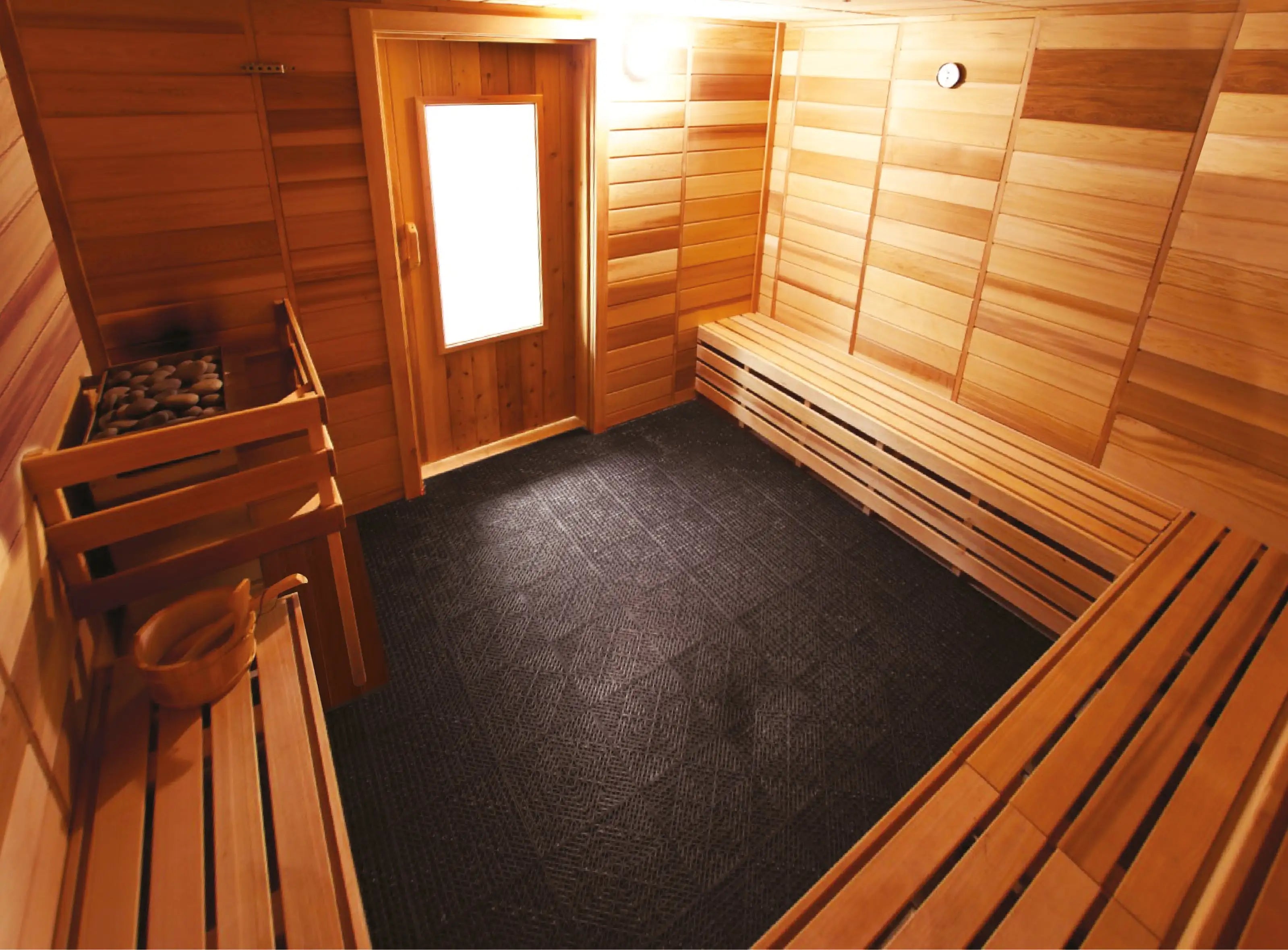
Modular rubber mats and interlocking PVC tiles are practical, affordable options — particularly for the walking areas of a sauna, changing rooms, and transition zones between hot and cold spaces. They provide cushioning, excellent slip resistance, and can be installed in minutes with no adhesive or tools.
Perforated designs are strongly preferred for sauna use. Tiles with drainage holes allow water to pass through to the subfloor instead of pooling on the surface, which keeps the walking surface safer and more hygienic. Many DIY sauna kits, including our complete room kits, include interlocking PVC floor tiles for exactly this reason — they're durable, waterproof, and easy to remove for cleaning.
One important caveat: not all rubber and PVC products are rated for sauna temperatures. Standard rubber floor mats designed for gyms or garages may off-gas at elevated temperatures or degrade faster than expected. Always verify that any rubber or PVC product you use is specifically rated for continuous high-temperature exposure (ideally 194°F / 90°C or higher). New rubber mats sometimes carry a mild odor — air them out for a few days before installation.
Best for: Changing rooms, transition areas, temporary setups, and as a removable surface layer over concrete or tile subfloors.
Natural Stone
Natural stone — slate, granite, marble, soapstone — brings an undeniable luxury aesthetic to a sauna floor. These materials are extremely durable and heat-resistant, and many types develop a beautiful patina over time.
However, natural stone has practical drawbacks in a sauna context. Most stone is porous and requires regular sealing (typically every few months in a high-humidity sauna environment) to maintain its water resistance. Without consistent sealing, stone absorbs moisture and becomes a habitat for mold and bacteria. Marble and polished granite can also become dangerously slippery when wet unless finished with a honed or textured surface.
Soapstone is an exception worth noting — it's naturally non-porous, retains heat beautifully, and doesn't require sealing. It's used extensively in Finnish sauna culture for heaters and bench surrounds, and works well as a floor accent. It is, however, expensive and heavy.
Best for: High-end custom sauna builds where aesthetics are a top priority and the owner is willing to commit to regular maintenance. Soapstone is best as an accent rather than a full floor.
The Two-Layer Approach: The Gold Standard
If there's one takeaway from this entire guide, it's this: the most effective sauna floor isn't a single material — it's a two-layer system combining a durable, waterproof base with a warm, removable walking surface.
The base layer handles the heavy lifting: moisture management, drainage, structural integrity, and long-term durability. Porcelain tile or sealed concrete are the best options here. Slope this layer slightly toward a floor drain if your sauna involves any water use (steam, löyly, post-session rinsing).
The top layer provides comfort and warmth: cedar duckboards, slatted wood mats, or rated PVC tiles placed in the primary walking and sitting areas. Because this layer is removable, you can periodically lift it to clean the base floor underneath — a significant advantage for preventing the buildup of sweat, skin oils, and moisture that causes odors over time.
This system works for virtually every sauna type and gives you the best of both worlds: a hygienic, virtually indestructible foundation underneath with a warm, comfortable surface where your feet actually touch.
Flooring Considerations by Sauna Type
Traditional (Finnish) Saunas
Traditional saunas involve the most moisture exposure of any sauna type. Pouring water over heated stones creates bursts of steam, and sweat accumulates throughout longer sessions. The floor needs to handle this moisture reliably. Tile or sealed concrete with a proper drain is ideal for the base. Cedar or thermally modified wood duckboards provide comfort underfoot. If you're building from a kit, most barrel saunas come with tongue-and-groove wood floors built in — these work well as long as the sauna is properly ventilated after each session.
Infrared Saunas
Infrared saunas operate at lower temperatures (typically 120°F–150°F) and produce far less moisture than traditional saunas. This opens up more flooring options. Hemlock, cedar, and even bamboo or composite flooring rated for moderate heat can work. Many pre-built infrared sauna cabins come with a built-in wood floor, and the lower thermal stress means these floors tend to last longer with less maintenance.
Outdoor Saunas
Outdoor saunas face the additional challenges of ground moisture, temperature extremes (especially freezing), UV exposure, and potential insect activity. Flooring for outdoor installations needs to be more robust. Insulated concrete with a durable coating, or porcelain tile over a properly constructed subfloor, are the strongest options. For outdoor DIY builds, ensure the subfloor is elevated off the ground (using posts, sleepers, or a gravel bed) to prevent ground moisture from wicking up into the structure. Cedar and thermally modified wood perform the best as surface layers in outdoor environments due to their natural weather resistance.
Indoor Saunas
Indoor saunas benefit from a controlled environment, which means the flooring doesn't need to withstand weather extremes. Many indoor sauna kits are designed to sit on your existing floor — tile, concrete, laminate, or vinyl all work as a base. The key consideration is ensuring your existing floor can handle some moisture exposure. Carpet is never acceptable as a sauna floor or base. If your existing floor is carpet or untreated hardwood, replace it in the sauna area with tile, vinyl plank, or another water-resistant material before installation.

Materials to Avoid in a Sauna
Some flooring materials that seem reasonable at first glance are genuinely unsuitable — or even unsafe — in a sauna environment:
Carpet. Absorbs moisture, traps bacteria, and creates the perfect conditions for mold growth. It also retains odors and is nearly impossible to keep sanitary in a sauna setting.
Laminate flooring. Standard laminate is constructed with layers bonded by adhesives that can degrade and off-gas when exposed to heat and moisture. The wear layer can delaminate, and the core material (typically MDF or HDF) swells rapidly when exposed to water.
MDF, particleboard, and standard plywood. These engineered wood products contain formaldehyde-based adhesives that release VOCs when heated. Even products marketed as "low emission" become problematic at sauna temperatures. Any exposed interior surface in a sauna should be solid wood.
Vinyl plank flooring (standard residential grade). While some vinyl can tolerate bathroom-level humidity, standard luxury vinyl plank (LVP) is not designed for the sustained heat inside a sauna. It can soften, warp, or release chemicals at elevated temperatures. The adhesives used in installation may also fail.
Unrated foam mats. Generic foam exercise mats are not manufactured to withstand sauna heat. They can degrade, off-gas, and become a fire risk near a heater.
Any material with a strong chemical odor. If it smells like chemicals at room temperature, it will be significantly worse inside a hot sauna. Trust your nose — if something doesn't smell right, don't install it.
Drainage and Floor Slope
If your sauna involves any water use — and most traditional saunas do — proper drainage matters. A floor sloped at approximately 1–2% toward a floor drain prevents water from pooling, keeps the surface safer, and protects your subfloor from sustained moisture exposure.
For saunas built on a concrete slab, the slope can be created during the pour or added afterward using self-leveling compound. For elevated wood-framed floors, sleepers of varying thickness can create the necessary grade. The drain itself should have a trap to prevent sewer gases from entering the room and should connect to an appropriate drainage line.
Even in saunas where you don't actively pour water, sweat drips to the floor throughout every session. Good drainage and airflow beneath any surface material make a meaningful difference in long-term cleanliness and material longevity.
Insulation Under the Floor
Floor insulation is an often-overlooked factor that directly impacts both comfort and energy efficiency. An uninsulated floor — especially a concrete slab on grade — acts as a massive heat sink, constantly drawing warmth out of the room and making the floor uncomfortably cold to stand on.
For slab-on-grade construction, rigid foam insulation (XPS or EPS) installed beneath the finished floor surface significantly reduces heat loss. For raised floor construction, mineral wool insulation between joists provides good thermal performance and doesn't trap moisture the way closed-cell foams can. Leave a small air gap (1–2 inches) between the insulation and the underside of the floor boards to allow moisture to evaporate rather than condense against the insulation layer.
Proper insulation means the sauna heater can bring the room to temperature faster with less energy, and the floor feels comfortable from the first session onward.
Maintenance and Cleaning
No matter what flooring material you choose, consistent basic maintenance extends its life dramatically:
After every session: Wipe down the floor to remove sweat and water. Leave the sauna door open (or cracked, at minimum) to allow airflow and drying. If you use removable duckboards or mats, prop them up so air circulates underneath.
Weekly: Clean the floor with mild soap and warm water. Avoid harsh chemical cleaners — they can damage untreated wood, degrade coatings, and leave residues that off-gas when the sauna heats up next. Diluted white vinegar is a safe and effective alternative.
Periodically: For modular mats, duckboards, or any removable floor surface, lift the pieces and clean the base floor underneath. This removes the accumulated sweat, skin oils, and debris that cause musty odors. For wood floors, light sanding followed by a sauna-safe wood treatment (if recommended by the manufacturer) can refresh the surface when it starts looking worn.
Annually: Inspect the floor and subfloor for any signs of water damage, mold, warping, or deterioration. Catch problems early and address them before they become structural issues. Check grout lines on tile floors and reseal natural stone if applicable.
Cost Comparison at a Glance
Flooring costs vary widely depending on material quality, sauna size, and whether you hire a professional or install yourself. Here's a general range for material costs per square foot to help frame your budget:
Sealed concrete (coating an existing slab): $3–$8 per square foot — the most economical option if you already have a concrete base in place.
Ceramic or porcelain tile: $5–$15 per square foot for materials, plus installation labor. Porcelain costs slightly more than ceramic but offers better durability and frost resistance.
Cedar duckboards or slatted mats: $8–$15 per square foot for quality cedar. Thermally modified wood runs $12–$20+ per square foot.
Interlocking PVC or rubber tiles: $3–$8 per square foot. Budget-friendly and require no installation labor.
Natural stone: $10–$30+ per square foot depending on the species. Professional installation strongly recommended.
Microcement: $80–$150 per square meter (roughly $8–$15 per square foot) including installation. A luxury option that creates a seamless, modern aesthetic.
Frequently Asked Questions
Can I use my existing bathroom tile as the floor for an indoor sauna?
Yes, in most cases. Ceramic or porcelain tile that's already installed in a bathroom is perfectly suitable as a sauna floor base. Confirm the tile is in good condition with intact grout, and that it has a non-slip surface. If the tile is smooth and glossy, add removable rubber mats or wood duckboards for traction and comfort.
How often should I clean my sauna floor?
Wipe down the floor after every session to remove sweat and moisture. Do a more thorough cleaning with mild soap and water weekly. For removable mats and duckboards, lift and clean the base underneath at least once a month.
Do barrel saunas need special flooring?
Most barrel saunas come with tongue-and-groove wood floors built into the design. These are adequate for the low-moisture environment inside a barrel sauna, but proper ventilation after each session is essential to prevent moisture buildup. Some barrel sauna owners add removable cedar or rubber mats for additional comfort and easier cleaning.
Should I put a drain in my sauna floor?
If you use a traditional sauna with a heater and stones (where you pour water for löyly), a floor drain is strongly recommended. It simplifies cleaning, prevents water pooling, and protects the subfloor from moisture damage over time. For infrared saunas, a drain is generally unnecessary since moisture levels are much lower.
Is it safe to use pressure-treated wood for a sauna floor?
Pressure-treated wood should not be used for any surface that contacts heated air inside the sauna, as the chemical preservatives can off-gas at elevated temperatures. However, it can be used for structural components like sill plates or subfloor framing that are buried beneath vapor barriers and insulation, where they aren't exposed to the heated sauna environment.
What's the best flooring for a sauna changing room?
The changing room doesn't face the same extreme heat as the sauna itself, so you have more flexibility. Water-resistant vinyl plank, tile, rubber mats, or sealed concrete all work well. Prioritize slip resistance and easy cleaning, since this is where wet feet transition between spaces. Quality sauna accessories like floor mats and towels help keep the transition area safe and dry.
Choosing the Right Floor for Your Sauna
The best sauna flooring ultimately depends on your sauna type, location, budget, and how much maintenance you're willing to commit to. For most home sauna owners, a tile or sealed concrete base paired with removable cedar duckboards delivers the ideal balance of durability, hygiene, comfort, and longevity. It's a proven system used in Finnish saunas for generations, and it works just as well in a modern home setup.
If you're still in the planning stages of your sauna project, explore our full selection of indoor saunas, outdoor saunas, and DIY sauna kits to find the right fit for your space. Many of our kits include flooring components designed specifically for the sauna environment, taking the guesswork out of material selection. And if you have questions about flooring, installation, or anything else related to your build, our team is here to help.




Leave a comment