

*Havenly 及其关联公司不提供医疗指导。医疗建议请咨询执业医生。本网站包含的所有信息仅供参考。使用我们产品的结果因人而异,我们无法提供立即永久或有保证的解决方案。我们保留更改文章中任何内容的权利,恕不另行通知。Havenly 对印刷差异不承担任何责任。


Red light therapy saunas represent the cutting edge of home wellness technology in 2026. By combining the deep-penetrating heat of infrared sauna therapy with targeted photobiomodulation from red and near-infrared LEDs, these dual-therapy units deliver benefits that neither technology can achieve alone. Whether you're recovering from intense training, targeting skin rejuvenation, or looking for a comprehensive daily wellness ritual, a red light therapy sauna consolidates what used to require two separate devices — and two separate sessions — into a single, time-efficient experience.
This guide breaks down exactly how red light therapy works inside a sauna, what to look for when shopping, and which models deliver the best results across every budget and space requirement. Every sauna featured below is available at Haven Of Heat with free shipping and flexible financing.

A red light therapy sauna is an infrared sauna — or in some cases a hybrid sauna — that includes built-in LED panels emitting clinically studied wavelengths of visible red light (typically 630–660nm) and near-infrared light (810–850nm). These wavelengths penetrate the skin at different depths: red light reaches the dermal layer to stimulate collagen production and support skin health, while near-infrared wavelengths penetrate deeper into muscle, joint, and connective tissue to reduce inflammation and accelerate cellular repair.
The sauna's infrared heating panels handle the thermal side of the equation. Full spectrum infrared saunas emit near, mid, and far-infrared wavelengths that warm your body directly rather than heating the surrounding air. This produces a deep, penetrating sweat at lower ambient temperatures (typically 120–150°F) compared to traditional saunas that heat the air to 170–200°F. When red light therapy runs simultaneously with infrared heat, you get a synergistic effect: the heat increases blood flow and dilates blood vessels, which helps your cells absorb more of the therapeutic light wavelengths.
It's worth noting the distinction between infrared heating and red light therapy — a point that causes frequent confusion. The infrared panels that heat your sauna operate primarily in the far-infrared range (roughly 5,000–15,000nm), which is excellent for generating sweat and deep tissue warmth but sits well outside the wavelengths used in photobiomodulation research. The red light therapy component uses separate LED panels tuned to specific narrow-band wavelengths that have been studied for cellular-level benefits. For a deeper dive into this distinction, our guide on red light vs. infrared light therapy in saunas covers the science in detail.
Red light therapy — also called photobiomodulation or low-level light therapy — works by delivering photons of light at specific wavelengths that are absorbed by chromophores within your cells, most notably cytochrome c oxidase in the mitochondria. This absorption triggers a cascade of biological responses that ultimately increase the production of adenosine triphosphate (ATP), the energy currency your cells use for virtually every function.
With more ATP available, cells perform their jobs more efficiently. Fibroblasts produce collagen faster. Inflammatory markers decrease. Damaged tissue repairs more quickly. Oxidative stress drops as antioxidant pathways activate. These aren't theoretical claims — hundreds of peer-reviewed studies published in journals like Photobiomodulation, Photomedicine, and Laser Surgery and the Journal of Clinical and Aesthetic Dermatology have documented these effects across a range of applications from wound healing to joint pain reduction to improved skin texture.
When you layer this on top of a sauna session, several things happen simultaneously. The infrared heat raises your core body temperature, stimulates circulation, and promotes sweating for detoxification. Your blood vessels dilate, delivering more oxygen-rich blood to tissues. In this state of enhanced circulation, your cells are primed to absorb the red and near-infrared wavelengths more effectively. Essentially, the sauna pre-conditions your body to get more out of the light therapy.
Red light at 630–660nm stimulates collagen and elastin production in the dermal layer of the skin. Multiple clinical studies have shown measurable improvements in skin roughness, fine lines, and overall complexion after consistent red light exposure. Inside a sauna, the heat opens pores and increases blood flow to the skin's surface, which may enhance the absorption and effectiveness of the light treatment. Many users report visibly improved skin tone and texture within 4–8 weeks of regular use.
Near-infrared wavelengths (810–850nm) penetrate deep into muscle and joint tissue. Research has demonstrated reduced delayed-onset muscle soreness (DOMS), decreased inflammation markers, and faster return to peak performance in athletes using photobiomodulation. Combined with the muscle-relaxing effects of infrared heat, a red light therapy sauna is one of the most efficient post-workout recovery tools available for home use.
Infrared saunas have been studied extensively for their cardiovascular benefits. Regular use has been associated with improved endothelial function, reduced blood pressure, and enhanced circulation. Red light therapy adds to this by stimulating nitric oxide production at the cellular level, which further supports blood vessel dilation and healthy blood flow.
Sauna bathing triggers the release of endorphins and reduces cortisol — the body's primary stress hormone. Red light therapy has been studied separately for its effects on mood and sleep quality, with research suggesting it may help regulate circadian rhythm and support serotonin production. The combination creates a powerfully relaxing experience that many users incorporate into their evening routine for better sleep.
Infrared heat produces a deep, profuse sweat that carries out heavy metals, environmental toxins, and metabolic waste products. While red light therapy doesn't directly contribute to sweating, its support of cellular metabolism and lymphatic function complements the detoxification process. For a detailed comparison of how each therapy handles detox differently, see our article on red light therapy vs. sauna for detox and relaxation.

Not all red light therapy saunas are created equal. The quality and implementation of the red light component varies dramatically between manufacturers. Here are the factors that actually matter when evaluating your options.
Look for saunas that use clinically validated wavelengths. The most researched and effective wavelengths are 630nm and 660nm for visible red light (skin-depth benefits) and 810nm, 830nm, and 850nm for near-infrared (deep tissue benefits). Some premium models offer additional wavelengths like 590nm (amber, for skin tone) and 940nm (deeper tissue penetration). The more wavelengths covered across the therapeutic window, the broader the range of benefits you'll receive.
Irradiance — measured in milliwatts per square centimeter (mW/cm²) — tells you how much light energy actually reaches your body at a given distance. Higher irradiance means shorter, more effective sessions. Look for panels delivering at least 50–70 mW/cm² at 6 inches. Some lower-quality saunas include decorative red LEDs that look impressive but deliver negligible therapeutic output. If a manufacturer doesn't publish irradiance specifications, that's a red flag.
A small red light panel mounted in one corner of the sauna will only treat a limited area of your body. The best red light therapy saunas either include large, strategically placed panels or multiple panels positioned to provide broad coverage. Front-mounted panels are most common since you'll typically face the panel during your session, but some models include panels on multiple walls for more comprehensive exposure.
Electromagnetic field emissions are a consideration with any infrared sauna, and the addition of LED panels introduces another potential EMF source. The best manufacturers design their red light panels with near-zero EMF output. Look for panels that test at zero detectable EMF at 6 inches or less. The infrared heating panels should also meet low or near-zero EMF standards — under 3 milligauss for ultra-low EMF, and under 2 milligauss (sometimes under 1 milligauss) for near-zero EMF models.
Red light therapy saunas come with different types of infrared heating: FAR infrared only, or full spectrum (near + mid + far infrared). Full spectrum infrared saunas deliver the widest range of infrared wavelengths, with each band offering distinct benefits. Near-infrared penetrates deepest for cellular regeneration, mid-infrared supports improved circulation and muscle recovery, and far-infrared promotes detoxification through sweating. If budget allows, a full spectrum model paired with red light therapy gives you the most comprehensive therapeutic coverage available in a home sauna.
The sauna cabin itself matters. Canadian Hemlock and Canadian Red Cedar are the two most common wood types in quality infrared saunas. Hemlock is hypoallergenic, durable, and carries a lighter aesthetic. Red Cedar is naturally aromatic, resistant to moisture and insects, and has a warm, rich appearance. Both are excellent choices — it largely comes down to personal preference and whether you enjoy the cedar scent during your sessions.
Most indoor infrared saunas with red light therapy plug into a standard 120V/15A household outlet — no electrician needed. Some larger models or those with more powerful heating systems may require a 240V dedicated circuit. Always check the electrical specs before purchasing, especially if you plan to place the sauna in a room with limited circuit capacity.
Below are our top-rated red light therapy saunas organized by category. Each model has been evaluated for red light quality, infrared performance, build construction, EMF levels, and overall value.
Finnmark Designs has established itself as the leader in integrated red light therapy saunas. Their full spectrum infrared models include high-output red light therapy panels with medical-grade wavelengths, near-zero EMF construction, and some of the best build quality in the industry. If you want the best red light therapy sauna available and budget is secondary to quality, Finnmark is the brand to consider.
If you want the best of every sauna world — traditional steam heat, infrared therapy, and red light therapy — all in one unit, the Finnmark Trinity series is unmatched. These hybrid saunas combine a traditional electric heater with sauna stones (for steam/löyly), full spectrum infrared panels, and integrated red light therapy. You can use each modality independently or combine them in any configuration.
The Finnmark Trinity FD-4 packs traditional steam, full spectrum infrared, and red light therapy into a 2-person cabin. Want a traditional Finnish-style steam session one day and a low-temperature infrared session with red light therapy the next? This sauna handles both without compromise. It's the ultimate all-in-one solution for sauna enthusiasts who refuse to choose between heating methods.

The Finnmark Trinity FD-5 is the flagship of the Trinity line, offering the same triple-therapy approach in a spacious 4-person cabin. With a larger traditional heater, more infrared panel coverage, and the integrated red light therapy system, this is the sauna you buy when you want everything and have the room for it. It's an exceptional choice for families or anyone building a dedicated home wellness space.

Dynamic Saunas is North America's best-selling infrared sauna brand, and several of their models now include integrated red light therapy panels. These saunas offer strong performance at a more accessible price point than premium brands, making them the best entry into red light therapy sauna ownership for budget-conscious buyers.
The Dynamic Gracia is a premium 1–2-person full spectrum infrared sauna with near-zero EMF and built-in red light therapy. It's constructed from Canadian Hemlock and offers an excellent combination of features, compact size, and value. For buyers who want full spectrum infrared with red light therapy without stepping up to Finnmark pricing, the Gracia is the model to consider.

The Dynamic Versailles Elite is a 2-person FAR infrared sauna with ultra-low EMF construction and an integrated red light therapy panel. Built from Canadian Hemlock, it delivers reliable infrared heating paired with red light therapy at a price point that makes dual-therapy accessible to a wider audience. If you're primarily focused on FAR infrared benefits with added red light and want to keep costs down, the Versailles Elite is a strong choice.

Maxxus Saunas offers a range of infrared saunas with integrated red light therapy, from compact 1-person S-Line models to spacious 4-person cabins. Their saunas feature PureTech heating elements, quality Canadian Hemlock or Red Cedar construction, and competitive pricing.
The Maxxus S-Line 2-Person Full Spectrum combines near-zero EMF full spectrum infrared with red light therapy in a sleek, modern design. Engineered for optimal wellness and comfort, it's a strong competitor in the mid-range full spectrum category. If you like the Maxxus aesthetic and want full spectrum with red light, this is their best offering.

The Maxxus 3-Person is built from Canadian Hemlock with near-zero EMF FAR infrared heating and an integrated red light therapy panel. It's an excellent choice for small families or anyone who wants a roomier sauna experience with the added benefit of red light therapy at a competitive price.

The Maxxus 4-Person is constructed from Canadian Red Cedar — naturally aromatic and moisture-resistant — with FAR infrared heating and red light therapy. If you need a large-capacity sauna with red light therapy and love the look and smell of cedar, this is one of the best options in its size class.

The Peak Saunas Shasta stands out for its XL medical-grade red light therapy panel delivering 8 optimized wavelengths across the 590–940nm range — one of the broadest spectrums available in any built-in sauna panel. Combined with 7 high-efficiency full spectrum infrared heating panels for 360° heat distribution, smart WiFi app control, and a higher temperature ceiling of 150°F, the Shasta is purpose-built for users who prioritize red light therapy performance above all else. The Peak Saunas brand also backs it with a lifetime warranty and lifetime USA-based support.

If you already own an infrared or traditional sauna and want to add red light therapy without buying an entirely new unit, sauna-rated standalone panels are the way to go. Standard red light therapy devices are not designed for the extreme heat and humidity inside a sauna — using one will void its warranty at best and cause electrical failure or safety hazards at worst.
We carry three purpose-built red light therapy panels for saunas that are specifically engineered for high-heat, high-humidity environments:
The 39" × 10" Sauna Red Light Panel features a fanless, all-aluminum design with an IP65 waterproof rating. It's built to withstand temperatures up to 150°F and full steam exposure, making it safe for use in both infrared and traditional saunas. It emits dual red (660nm) and near-infrared (850nm) wavelengths with adjustable intensity, a remote control, and an integrated timer. If you want the largest coverage area and the most rugged build, this is the panel to choose.
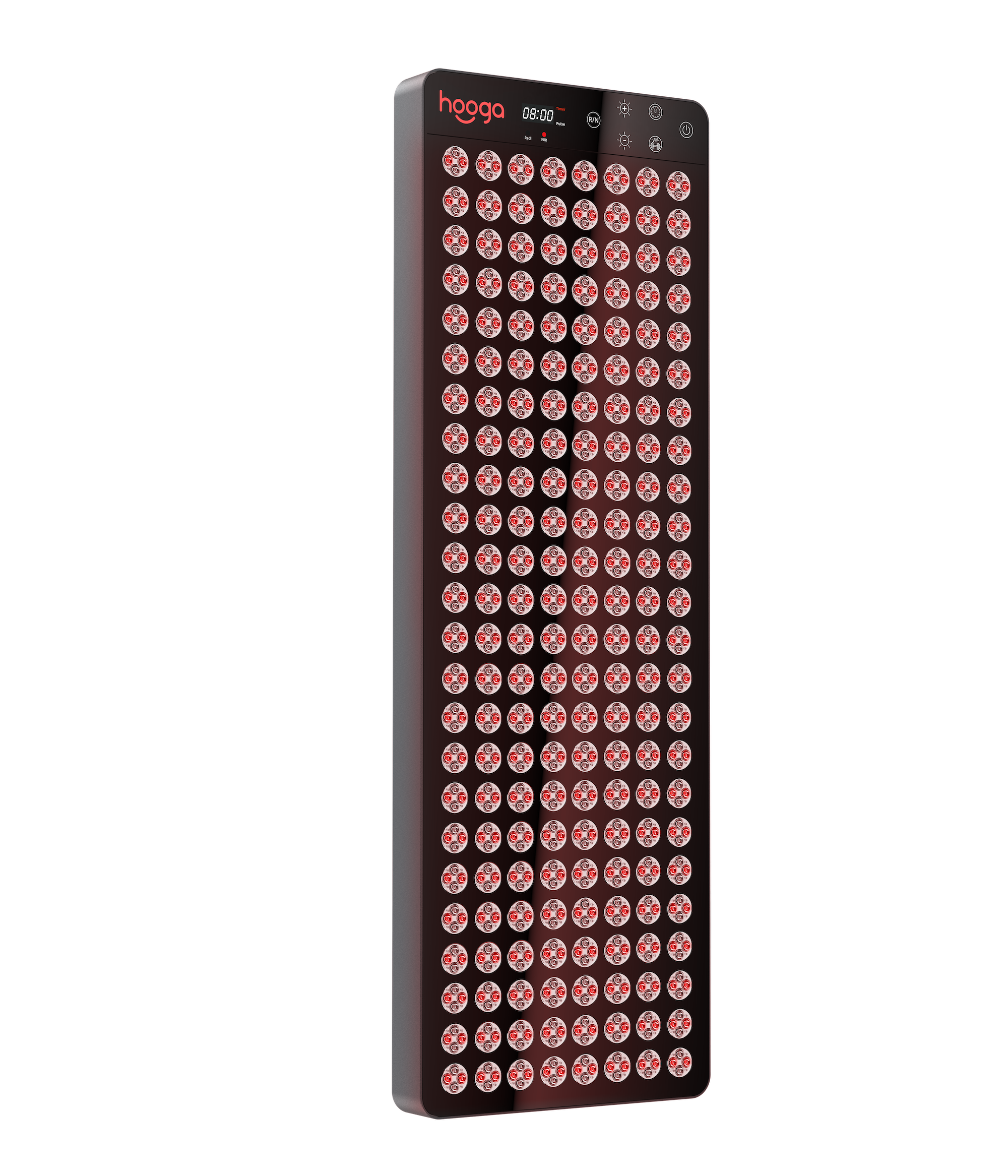
The Hooga Ember packs 384 LEDs across four clinically studied wavelengths — 630nm and 660nm red plus 810nm and 850nm near-infrared — into a compact, sauna-rated panel. Its sealed IP65 aluminum housing and internal driver handle temperatures up to 194°F in both infrared and traditional saunas. Irradiance measures 111 mW/cm² at 6 inches (up to 175 mW/cm² max), and it offers touch controls, a 1–20 minute timer, adjustable brightness, and 10Hz/40Hz pulse modes. With zero detectable EMF at 4 inches, it's the best pick for personal saunas and tighter spaces.
The Hooga Blaze doubles the Ember's output with 768 LEDs across the same four wavelengths (630nm, 660nm, 810nm, 850nm), delivering full-body coverage from a single panel. It shares the sealed IP65 aluminum housing and 194°F rating, adds dual cooling fans for high-frequency use, and produces 109 mW/cm² at 6 inches (up to 185 mW/cm² max). Touch controls, a 1–20 minute timer, adjustable brightness, 10Hz/40Hz pulse modes, and zero detectable EMF at 4 inches round it out. Choose the Blaze for larger saunas and full-body sessions.

There are two paths to combining red light therapy with sauna heat: buy a sauna with built-in red light, or add a standalone sauna-rated panel to an existing sauna. Both work. Here's how to decide.
A sauna with built-in red light therapy is the better choice if you're buying a new sauna anyway, you want a clean and integrated setup with no extra wiring, or the manufacturer has optimized the panel placement for maximum coverage. Built-in systems are also typically included in the sauna's warranty and support coverage.
A standalone sauna-rated panel makes more sense if you already own a sauna you're happy with, you want the flexibility to position the panel exactly where you need it (bench level for seated sessions, wall-mounted for standing), or you want to upgrade to a higher-output panel than what some built-in saunas offer. Standalone panels also let you use the same device outside the sauna — for pre-workout preparation, facial treatments, or targeted therapy on specific injuries.
Getting the most from your red light therapy sauna comes down to positioning, timing, and consistency.
Red light follows the inverse square law — intensity drops rapidly as distance increases. For maximum benefit, position yourself 6–12 inches from the red light panel. Most users sit or recline on the sauna bench with the panel at torso or face level. If your sauna has the panel mounted on the front wall, face it directly during your session. Rotate periodically to expose different areas of your body.
A typical combined session runs 20–30 minutes. The infrared heaters benefit from a 10–15-minute preheat period (most saunas reach operating temperature in this window), while the red light panel can be turned on immediately since it doesn't require warm-up time. Some users prefer to start the red light treatment a few minutes into the session once the heat has increased blood flow and opened pores.
For general wellness maintenance, 3–5 sessions per week is the sweet spot backed by most photobiomodulation research. Athletes in heavy training may benefit from daily sessions focused on recovery. Start with 3 sessions per week and adjust based on how your body responds.
Red light therapy works best on bare skin. Clothing, towels, and even thin fabric significantly reduce the light energy reaching your cells. Since you're already in a sauna where minimal clothing is the norm, this is naturally taken care of — just make sure you're not blocking the panel with a towel draped over your shoulders.
The biggest mistake buyers make is purchasing a sauna with low-quality red light that looks impressive but delivers negligible therapeutic output. A strip of decorative red LEDs around the ceiling is not the same as a purpose-built photobiomodulation panel with verified irradiance. Always check for published wavelength and irradiance specs before buying.
The second most common mistake is using a standard (non-sauna-rated) red light therapy panel inside a sauna. Regular panels are not designed for temperatures above 95–105°F. At sauna temperatures, internal components can overheat, wiring insulation can degrade, and the device can fail — potentially creating a safety hazard. Only use panels that are specifically rated for high-heat, high-humidity environments with an IP65 or equivalent protection rating.
Finally, don't expect instant results. Red light therapy is a cumulative treatment. The cellular benefits build over weeks of consistent use. Most clinical studies showing measurable results used protocols of 3–5 sessions per week over 4–12 weeks. Stick with it, and the results will follow.
Yes, when using a sauna with built-in red light therapy or a sauna-rated standalone panel. The wavelengths used in red light therapy (630–850nm) are non-ionizing and non-UV — they don't damage skin or DNA the way ultraviolet light can. The primary safety consideration is ensuring any panel used inside a sauna is specifically designed for high-heat and high-humidity conditions.
You can add a sauna-rated red light therapy panel to virtually any sauna — infrared, traditional, or hybrid. The key requirement is that the panel is rated for the temperatures and humidity levels your sauna produces. Our sauna-rated red light therapy panels are designed to work in environments up to 150–194°F with full moisture exposure.
A regular infrared sauna uses heating panels to warm your body and produce sweat. A red light therapy sauna includes those same heating panels plus separate LED panels that emit specific red and near-infrared wavelengths studied for cellular benefits like collagen production, reduced inflammation, and faster tissue repair. The infrared heating and red light therapy serve different purposes and target different biological mechanisms.
FAR infrared saunas emit only far-infrared wavelengths for heating, which are excellent for deep sweating and detoxification. Full spectrum infrared saunas emit near, mid, and far-infrared wavelengths, offering a broader range of therapeutic benefits from cellular regeneration to pain relief to detox. When paired with red light therapy, a full spectrum model provides the widest possible range of wavelengths and health benefits.
Most red light therapy saunas designed for home use plug into a standard 120V household outlet. The red light panel runs on standard household power and doesn't drive the electrical requirement — even a larger standalone sauna panel like the Hooga Blaze (340W) operates on a normal outlet. Some larger saunas may require a 240V circuit, but this is related to the sauna's heating requirements, not the red light component.
Most users report subjective improvements in relaxation and skin feel within the first few sessions. Measurable improvements in skin texture, muscle recovery time, and joint comfort typically become noticeable after 4–8 weeks of consistent use at 3–5 sessions per week. Red light therapy is cumulative — consistency matters more than session length.
Space planning is straightforward for most indoor saunas. A 1-person red light therapy sauna typically requires about 4' × 3.5' of floor space — roughly the size of a small closet. A 2-person model needs approximately 4' × 4.5', and a 3–4-person sauna runs about 5' × 4.5' or larger. You'll also want to leave 2–4 inches of clearance on all sides for airflow and make sure the ceiling height accommodates the sauna's full dimensions.
Placement options include spare bedrooms, basements, garages (as long as they're fully enclosed and climate-controlled), walk-in closets, master bathrooms, and home gyms. The sauna can sit on any level surface including carpet, hardwood, tile, or concrete. No plumbing, no ventilation ductwork, and no special flooring required.
If you're not sure which size or model is right for your situation, our full sauna collection lets you filter by person capacity, heating type, brand, and features. You can also request a custom sauna quote if you have specific space requirements that off-the-shelf models don't address.
Every red light therapy sauna we carry ships free within the United States, direct from the manufacturer for the fastest possible delivery. We offer easy 0% APR financing through Shop Pay for 6–24 months so you can start using your sauna now and pay over time. Every product includes the full manufacturer's warranty, and our US-based sauna experts are available by phone or chat at (360) 233-2867 — before, during, and after your purchase.
We're not a generic marketplace. We specialize exclusively in saunas, cold plunges, red light therapy devices, and wellness equipment. That focus means we know these products inside and out and can help you choose the right model for your specific goals, space, and budget. Browse our complete collection of red light therapy saunas to find your perfect match, or visit our Sauna Learning Center for more in-depth guides on every aspect of sauna ownership.
*Havenly 及其关联公司不提供医疗指导。医疗建议请咨询执业医生。本网站包含的所有信息仅供参考。使用我们产品的结果因人而异,我们无法提供立即永久或有保证的解决方案。我们保留更改文章中任何内容的权利,恕不另行通知。Havenly 对印刷差异不承担任何责任。
placeholder


发表评论